CONTENTS09 +
The Web Gallery of Art has been online since 1996, and for most of that time it has looked much the same.
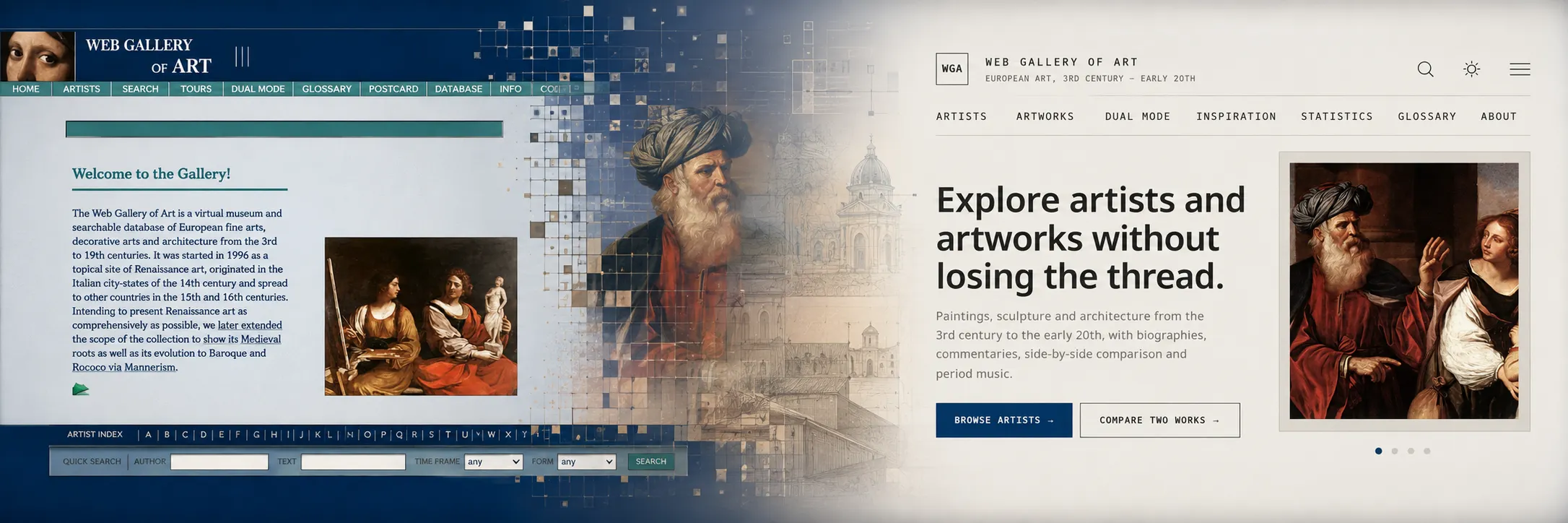
Emil Krén and Daniel Marx started the gallery on the early web, and over the years it grew into a large virtual museum of European art: more than 52,000 reproductions by more than 5,800 artists, with biographies, commentaries, guided tours, period music and a glossary alongside them.
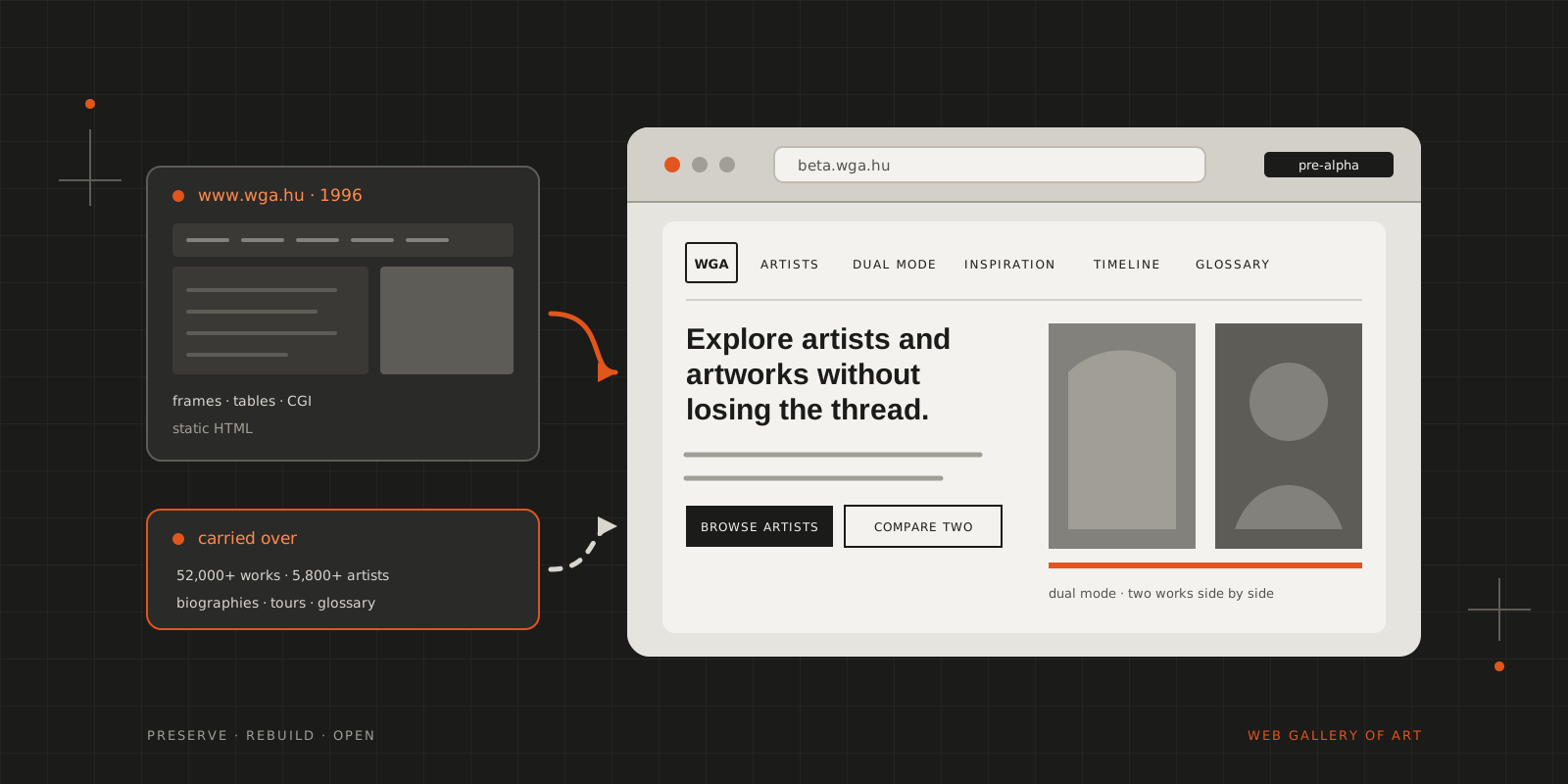
The rebuilt version is now public at beta.wga.hu. Despite the address, I wouldn’t call it a beta yet. It’s closer to a pre-alpha: some things work, some half work, and some quite enthusiastically don’t work at all. But it’s far enough along that you can see where it’s heading, and at this point feedback from people using it is worth more to me than another few months of working on it alone.
Why modernise it
Thirty years is a very long time for a website. In that time phones and tablets took over from desktops, HTML changed, accessibility became a basic requirement, search engines became how most people find things, and browsers picked up features nobody building a site in 1996 would have imagined. Plenty of sites built a decade or two later are already gone. The original WGA is still here.
Staying alive that long had a price, though. The site was still built the way sites were built when it started: frames, table layouts, images as navigation, static HTML and CGI scripts. And it wasn’t only the look. The content, the presentation and the machinery behind them had grown into each other. Some sections could be regenerated from the metadata stored with the images, while the biographies, tours, glossary, music pages and the rest each followed their own structure and conventions. Keeping it running depended less on having the files than on knowing, from decades of experience, how they fitted together.
So the real question wasn’t how to give the old site a fresh coat of paint. It was how to keep the gallery itself while replacing everything it runs on.
Digging the data out first
That’s why the work didn’t start with a new homepage. It started with getting the data out.
The existing site had to be treated as a website and as a historical dataset at the same time: recovering the artwork metadata, parsing the old HTML, finding the character-encoding problems, normalising locations, and turning thirty years of organically grown information into something an application can query. It was a lot more interesting than feeding the HTML into a converter and hoping it would sort itself out.
The data is messy in the way historical data usually is. Dates are uncertain or approximate, the same museum turns up under several names, city names can be ambiguous, some artists have incomplete dates, and the conventions changed over the years the gallery was maintained. Those irregularities can’t just be tidied away to make the database look neat, because often the uncertainty is the accurate answer. So the source material is kept as it is, separated from the code that used to display it. The aim is to give the gallery’s scholarship a structured, maintainable home, not to rewrite it.
Keeping what’s there
There was an easier way to do this: take the artwork database, drop everything awkward to migrate, put the images in a fashionable gallery template and call it WGA 2.0. It would also have thrown away a good part of what makes the gallery worth keeping.
WGA is a lot more than a set of images. The artist biographies, the commentaries, the guided tours, the glossary and the period music all matter, and so do the smaller things like the postcard service. They’re part of the character the site picked up over its lifetime. So the rule I’m sticking to is fairly stubborn: nothing disappears just because it’s inconvenient to migrate.
That goes for the design as well as the data. The new WGA shouldn’t turn into yet another endless grid of image cards; it should still feel like the Web Gallery of Art, even though almost everything underneath is being rebuilt. Old links should keep working wherever possible, you shouldn’t need an account to look at art, the existing editorial material shouldn’t be quietly rewritten, and new features should add to the collection rather than bury it.
What’s already there
Enough of this is in place that you can try it.
The new interface works on today’s screens instead of a fixed desktop window. Artists and artworks have their own proper records that you can browse and filter, and search is becoming the main way around the site rather than a separate tool. Dual Mode opens two artworks side by side, so comparing two works by the same artist, or two treatments of the same subject, no longer means juggling browser windows. The Inspiration section is for when you don’t arrive with a name in mind and just want to wander through a collection that can feel overwhelming. There’s keyboard navigation throughout for people who’d rather not reach for the mouse, a light and a dark theme, and the artist and artwork indexes are being rebuilt around filtering instead of long static lists.
The existing features are coming across too: the postcard service, the glossary, the guestbook, the statistics and the rest are finding their place in the new structure. Some are much further along than others, which is exactly why this is a pre-alpha.
New ways into the collection
Rebuilding the old gallery is only the first half. Once the collection is structured data, there are new ways to explore it that don’t touch the scholarship at all. The timeline places artists and artworks in time, so you don’t have to go in through names and schools. A geographical view can connect works with cities, museums and collections. Analysing the images themselves allows searching by colour and tone, which is a completely different way into the gallery.
These features keep a clear line between what the curators recorded and what software worked out. A computer can reliably tell you things about the digital image of a painting, like its dominant colours, dimensions or contrast. It can’t decide that two works belong to the same historical series because their descriptions sound alike. Some relationships in the collection exist only in the free-text commentaries, and some were never written down at all. Language models can suggest possible connections, but “the computer thinks this is probably true” doesn’t replace scholarship. So where the gallery knows something, it says so; where software derived it, it says that; and where nobody knows, the interface has to be able to say that too.
Built in the open
The other big change is underneath. The new application is developed in the open: the source code is public, changes can be reviewed, problems can be reported and anyone can contribute.
That matters for something like WGA. A cultural resource that’s meant to last decades shouldn’t depend on one person’s computer, an undocumented deployment process, or one maintainer remembering why an odd set of files behaves the way it does. I want to leave behind something another developer can understand, rebuild and keep running.
It’s personal for me as well. Emil Krén, the gallery’s curator and one of its creators, is my grandfather, and WGA was always somewhere in the background while I grew up, long before I understood what it takes to keep something like this alive for decades. My part isn’t to replace that work. It’s to make sure the technology carrying it isn’t the reason it eventually disappears.
Why open it this early
Developers usually go to great lengths to avoid showing unfinished software to the public. There’s always another bug, another page to finish, another suspicious mobile breakpoint waiting to ruin someone’s afternoon. But at some point working on it privately starts doing more harm than good, and we’re there now.
The direction is settled, enough of the collection has been rebuilt for the site to be usable, and enough of the interface exists for people to have real opinions about it. What I can’t work out on my own is how thousands of different people will actually use it. Someone researching a particular painter uses WGA very differently from someone who’s just discovered Hieronymus Bosch and wants to see how deep the rabbit hole goes. Someone on a phone needs different things from someone comparing works on a big monitor. And long-time WGA users know habits, shortcuts and corners of the old site that a rebuild can easily underestimate. That’s why feedback is useful now, and not only once it’s nearly finished.
How you can help
If you try the new gallery, please don’t treat it as finished. Explore it: search for something obscure, follow links, compare artworks, try it on your phone, try the things you used on the original WGA, and look for something you know should be there. Then tell us when something feels off.
Useful feedback includes:
- something that doesn’t work;
- content that seems to be missing or wrong;
- navigation that’s confusing;
- information that’s harder to find than on the original site;
- accessibility or usability problems;
- odd behaviour on particular devices;
- features of the original WGA that you rely on;
- new ways of exploring the collection that would genuinely help you.
You don’t need to be a developer or an art historian to send it. Hearing from both, and from everyone in between, is part of the reason for opening it now. A technically perfect museum that nobody enjoys visiting would be quite an impressive engineering failure.
What comes next
It isn’t finished. There are incomplete pages, missing features, bugs and data that still needs checking. Parts of the original gallery haven’t reached their final form yet, and several of the more ambitious exploration features are still being built.
What has changed is that the new Web Gallery of Art now exists outside my development environment. It has a home, you can explore it, and for the first time the people who use it can help decide what it becomes. The original showed that a carefully looked-after cultural resource can last almost the whole history of the public web; this project is meant to give it a foundation for the next stretch.
That starts at beta.wga.hu. Just remember that pre-alpha means pre-alpha: if you find something broken, you may have found a bug, and if you find several things broken, you’re probably getting the intended experience. Either way, we’d like to hear about it.