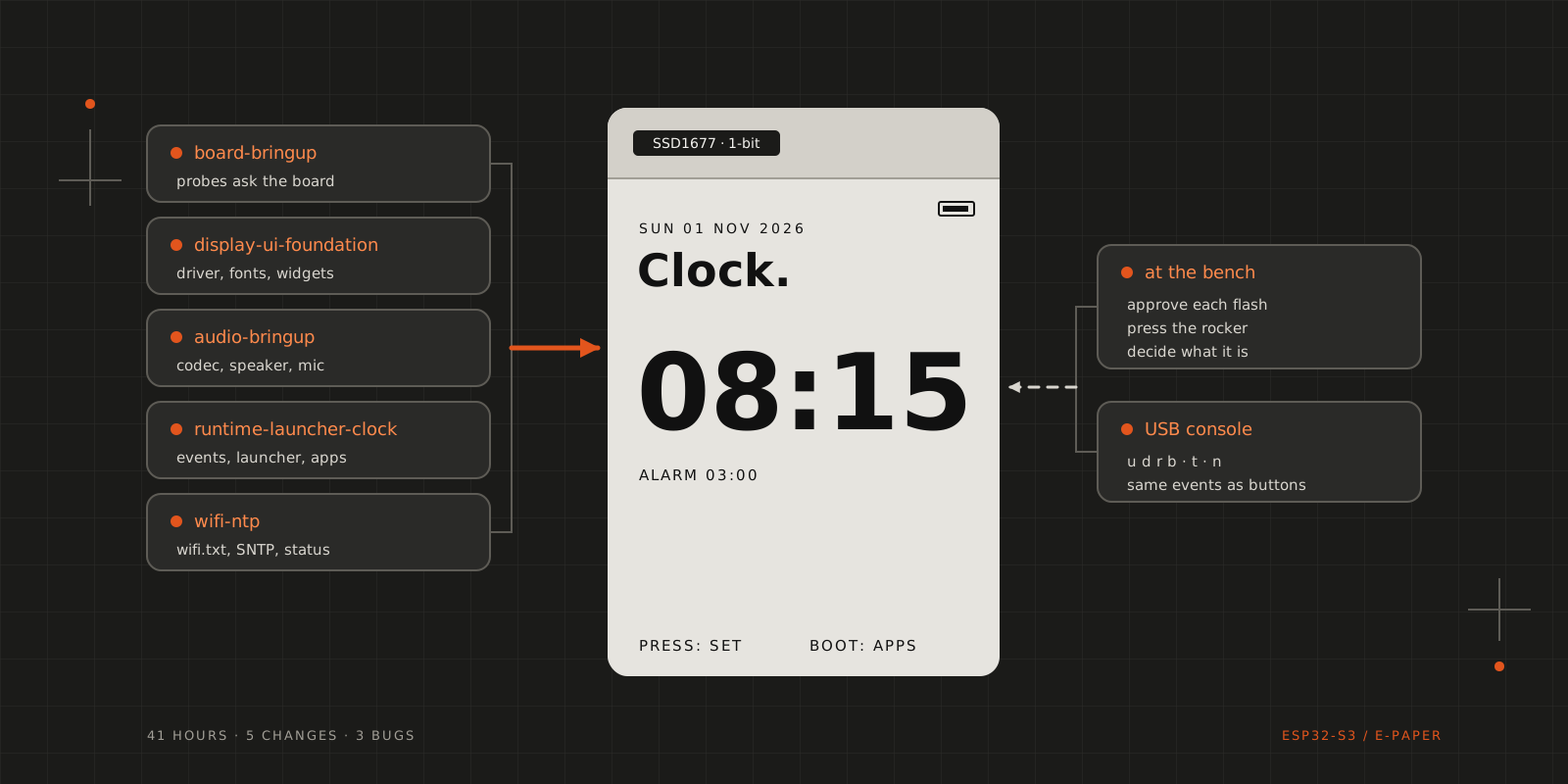
How Claude Code and I took a Waveshare e-paper board to a launcher and two apps in 41 hours, and where the time, the bugs and the open work went.
On a Friday at five past three I plugged a Waveshare e-paper board into my desktop, and it didn’t show up on USB. Forty-one hours later it ran a launcher, a clock with an alarm, a focus timer and a time sync over Wi-Fi. Claude Code wrote the firmware from the datasheets, while I stood at the bench pressing buttons, approving every flash and deciding what the device should be. Both nights went on sleep, so the active time was nearer 13 hours, a figure that moves between 10 and 17 depending on how you count the pauses.
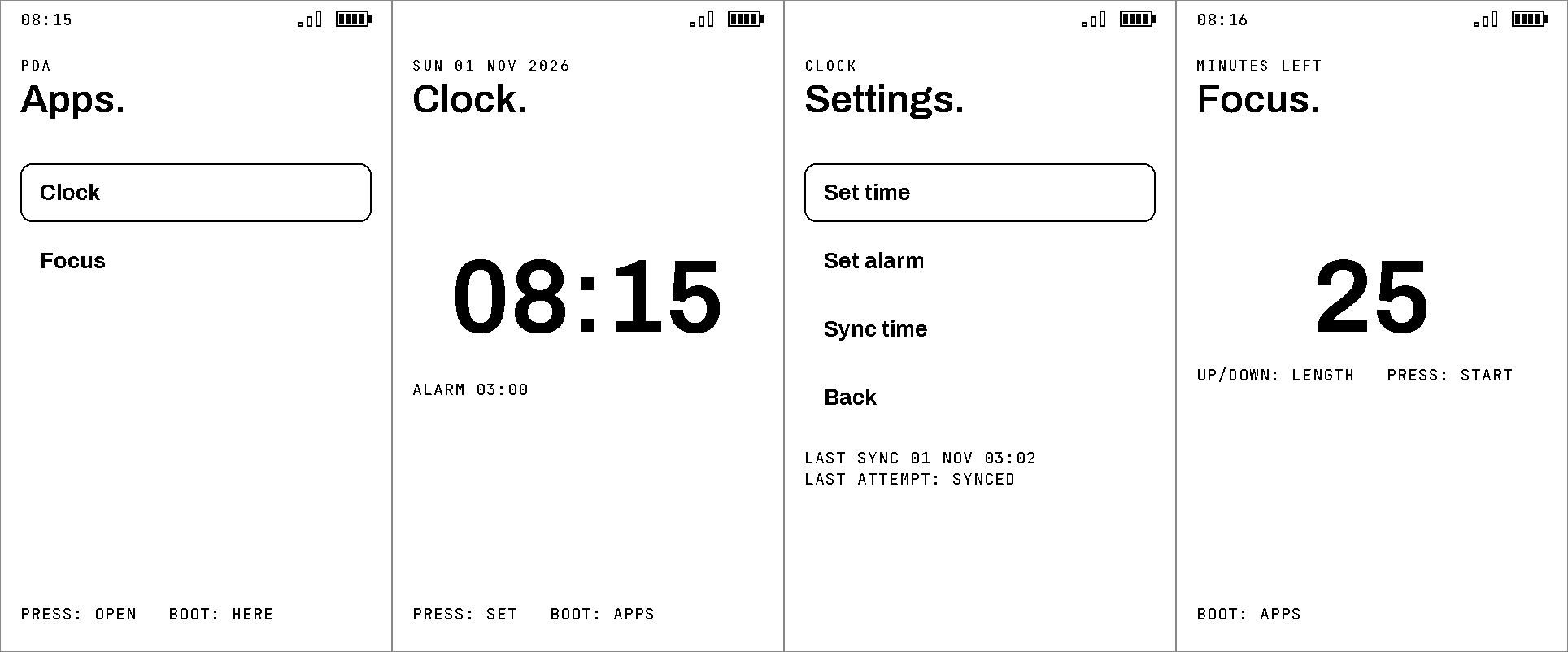
The board is Waveshare’s ESP32-S3-ePaper-3.97: an ESP32-S3 with 8 MB of PSRAM and a 3.97-inch, 800 × 480 panel that shows black, white and two greys. Around them sit a rocker that tilts up and down and presses in, a speaker header and a microphone, a real-time clock, and a power-management chip that keeps the board switched on. It lives in a 3D-printed case, FolloUp by alxvtoronto. By Sunday morning it had four screens: the app launcher, the clock, the clock’s settings and a focus timer.
I planned the work with OpenSpec, which has you write a change down before anyone builds it. A change starts as a proposal that says why and what, and gets a design that records each decision with the alternatives it beat. It ends in a task list. Claude Code works through the tasks, and once they pass, the change is archived and its requirements join the project’s specification. Over the weekend there were five:
| Change | What it built | Wall-clock | Active (estimate) |
|---|---|---|---|
board-bringup | Probe programs that each ask the board one question | Fri 15:30-22:26, Sat 08:44-09:09 | 4.1 h |
display-ui-foundation | Panel driver, renderer, fonts and widgets from the design system | Sat 04:56-07:58 | 1.9 h |
audio-bringup | Codec, speaker and microphone | Sat 07:58-08:43 | 0.75 h |
runtime-launcher-clock | Event loop, launcher, clock and alarm, focus timer | Sat 09:23-15:23 | 2.8 h |
wifi-ntp | Wi-Fi from the SD card with encrypted passphrases, time sync, status line | Sat 15:24-19:11 | 1.8 h |
The first change wrote no product code. The later designs depended on how the board behaved, and neither Waveshare’s documentation nor the datasheets settled that, so the probes asked first.
Together, the changes produced eight firmware components on ESP-IDF. Button presses and console commands both enter through the runtime, which hands the apps the same events either way:
Counting the hours
The active-time estimate comes from the two session transcripts. I added up every gap between consecutive events that was shorter than 15 minutes, on the assumption that a longer gap meant nobody was working. With a 5-minute threshold the total drops to 10.1 hours, and with a 30-minute one it rises to 17.5. The count also misses time I spent at the board without typing anything, and it counts short waits for me as work.
A good share of the wall-clock went on the agent waiting for me. Every flash needed my approval, and on Friday afternoon the first one waited 70 minutes because I was away. Claude Code used the wait to write the board code blind. When I came back the board didn’t enumerate, which cost another 19 minutes. On Saturday morning it waited 51 minutes for me to come and look at the panel. When I said I couldn’t press buttons for three hours, it switched to tests that needed no hands and logged 61 wakes in an hour.
Over the weekend I typed about 129 messages and answered seven multiple-choice questions. Most of the messages approved a flash, granted a permission or acknowledged a result, and the rest reported what I saw at the bench or what I wanted changed: a letter too thin to read, a screen that gave no sign it had seen a button press, a beep for every press. Only a handful were decisions that nobody else could make, such as how many partial refreshes the panel may do before a full one (“set it to 20”), or that an alarm rings on time even when a time sync has just moved the clock.
Three bugs and two reviews
The first bug was in the panel driver. A probe drew a box in one region of the screen by partial refresh, and the box landed mirrored about the panel’s centre. The window code had copied the convention in Waveshare’s examples, which pass panel rows to the controller as RAM rows, while this panel shows RAM row r as row 479 − r. Waveshare’s full-screen writes are only one row off, so their demos look right. Claude Code tried two wrong explanations, and one fix that scrambled the whole image, before the leftover ends of a box line in a webcam photo settled it, nine minutes in all.
The second only showed up once the clock had an alarm. The real-time clock’s alarm output is wired to the power key, so that an alarm can switch the board on from off. A ringing alarm holds that line low, and the power-management chip reads that as a long press and switches off, so the board powered down halfway through its own alarm. The same hunt turned up a daily alarm that compared only hours and minutes and so rang on the wrong day, and a ring that started three to seven seconds late. Fixing them took four rounds of flashing and waiting, about half an hour.
The third was Claude Code’s own. Until the real eFuses are burned, the Wi-Fi change keeps the device key in a region of flash that stands in for them. Flashing the older specimen firmware, which still used the original partition table, wrote its application over that region, so the encrypted Wi-Fi passphrases on the SD card could no longer be decrypted. I rewrote the file in plain text, the specimen moved to the shared partition table, and the project’s instructions now require every firmware flashed to the board to use it. It cost 27 minutes, including my trip to swap the card.
The Wi-Fi change also went through two reviews. Before it was finished, a second Claude Code agent reviewed its diff and raised 14 findings, among them an interrupted eFuse burn that could use up a second key block. Afterwards, three Codex reviews running in parallel raised 18, such as a partial read from the SD card that could be encrypted and written back over the rest of the file.
Unfinished work
Two of the five changes are still open. board-bringup has 23 of its 28 tasks done, and the missing ones include the battery run-down, so I still don’t know what the board draws in deep sleep. I have no current meter, and the power-management chip can’t measure current, so the run-down from a full charge is the only estimate available, and it’s on hold. wifi-ntp still has to burn the real eFuse key and be tested on battery.
Two smaller defects are known. After a cold start, the first command sent over the console is lost, which happened in all three runs that captured this post’s screens; its cause hasn’t been found. The alarm rings in bursts every 1.7 seconds instead of every second, because the audio codec is opened and closed for each burst.
The next posts take the method apart: the probes that asked the board before any firmware was written, the webcam and microphone that let Claude Code check its own work, and the console commands that took over most of my button presses.
CITE THIS POST
Referencing this in a paper or thesis? Here’s a BibTeX entry.
1@misc{galicz2026paper,2 author = {Galicz, Mikl{\'o}s},3 title = {{Building an e-paper PDA with Claude Code over a weekend}},4 year = {2026},5 month = nov,6 howpublished = {\url{https://blackfyre.ninja/blog/building-an-e-paper-pda-with-claude-code-over-a-weekend/}},7 url = {https://blackfyre.ninja/blog/building-an-e-paper-pda-with-claude-code-over-a-weekend/},8 urldate = {2026-11-17},9 note = {Blog post, blackfyre.ninja}10}